Charles Mistretta remembered as a pioneer in medical imaging

Charles “Chuck” Mistretta, PhD, a pioneering researcher who transformed the field of medical imaging, passed away on June 9, 2026. The University of Wisconsin–Madison professor emeritus of medical physics, radiology, and biomedical engineering had a profound impact on both the field as well as his students and collaborators.
“Chuck was an inspiring colleague whose spirit of innovation knew no limits,” UW Department of Radiology Chair Scott Reeder, MD, PhD, said. “He encouraged students to make the world a better place, and his work transformed medical imaging and human health.”
“Chuck shaped the Department of Medical Physics in fundamental ways, from its intellectual direction to its culture of innovation,” said UW Department of Medical Physics Interim Chair Michael Speidel, PhD. “He showed that when deep physical insight is combined with close collaboration with physicians, it can lead to technologies that transform clinical practice, from digital subtraction angiography to later advances in MRI and time-resolved imaging. I most appreciated his creativity and enthusiasm for new ideas, his ability to inspire colleagues, and his kind and generous nature. He will be deeply missed.”
Pathway to Medical Physics
Dr. Mistretta’s path to medical physics was anything but ordinary. He trained as a high-energy physicist earning a PhD from Harvard University in 1968, and came to the University of Wisconsin–Madison for postdoctoral work in physics. At that time, he could not have known that Wisconsin would become not only his academic home, but also the place where he would help transform the future of medical physics and medical imaging.
Dr. Mistretta often said that Wisconsin held a special place in his heart, in part because of childhood memories and his lifelong love of fishing. But it was his special gift as a teacher that helped anchor him at UW–Madison. As a young physicist, he taught large introductory physics courses and quickly became beloved by his students. When no tenure-track position was available for him in high-energy physics and he began looking for opportunities elsewhere, his students made their feelings known. As Dr. Mistretta later recalled, several hundred students marched to the dean’s office demanding that the university find a way to keep him at UW–Madison.
That moment became a turning point. UW–Madison did find a way. Through the vision of Professor John Cameron and the openness of the Department of Radiology, Dr. Mistretta was appointed assistant professor of physics and radiology, with the opportunity to teach physics and begin research in medical imaging in the radiology department. What might have seemed like an unexpected detour became the beginning of an extraordinary career.
This transition from high-energy physics to medical physics revealed one of Dr. Mistretta’s defining qualities: his ability to bring deep physical insight into unfamiliar territory and see possibilities that others had not yet imagined. He entered medical imaging without conventional training in the field, but with an uncommon combination of mathematical and physical intuition, experimental courage, engineering instinct, and clinical curiosity. Over the next five decades, that combination would help shape modern angiographic imaging, inspire generations of students and collaborators, and establish Dr. Mistretta as one of the most original and influential figures in medical physics.
A Career of Groundbreaking Research
Dr. Mistretta’s scientific career was defined by a rare ability to imagine technologies before they existed, build them with extraordinary collaborators, and carry them all the way from physical principle to clinical practice. His work did not simply improve medical imaging; rather, he repeatedly changed what medical imaging could do in radiology practice.
His most celebrated contribution was the development of Digital Subtraction Angiography (DSA), a technology that transformed vascular imaging by allowing physicians to visualize blood vessels in real time with greatly improved clarity. Working with a multidisciplinary team at UW–Madison, including key clinical collaborators such as Dr. Andrew Crummy and Dr. Charles Strother, Dr. Mistretta helped move angiography from analog film-based toward real-time digital imaging. The result was a new imaging platform that became central to the diagnosis and treatment of vascular disease and helped enable the growth of minimally invasive image-guided interventions.
DSA reflected the essence of Dr. Mistretta’s scientific style. He understood that a true imaging breakthrough required more than a clever algorithm or a new device. It required physics, engineering, computation, clinical insight, and practical translation to come together. Under his leadership, concepts that began in the laboratory were transformed into instruments that could be used in the clinic, licensed to industry, and disseminated around the world. This commitment to clinical translation became a hallmark of his career.
After helping revolutionize X-ray angiography, Dr. Mistretta turned his imagination toward magnetic resonance angiography (MRA). In collaboration with colleagues, including Thomas Grist, MD, Frank Korosec, PhD and others, he helped develop Time-Resolved Imaging of Contrast Kinetics (TRICKS), a major technological advance in time-resolved contrast-enhanced MR angiography. TRICKS improved the ability to capture the passage of contrast through the vascular system, reducing uncertainty in scan timing and giving physicians a clearer view of vascular dynamics.
Dr. Mistretta’s research continued to push imaging beyond conventional speed limits. His later work on Vastly Undersampled Isotropic Projection Reconstruction (VIPR), and Highly Constrained Back Projection (HYPR), opened new pathways to accelerate image acquisition and reconstruction in MRI and other fields. These methods reflected a bold philosophy that characterized Dr. Mistretta’s thinking throughout his career: do not simply accept the limits imposed by conventional imaging, but rethink the problem from the ground up.
That same spirit carried into 4D DSA and other time-resolved imaging methods, where his work continued to expand the ability to visualize anatomy and flow dynamically rather than as static images alone. Across X-ray, CT, and MR imaging, Dr. Mistretta’s career was united by a central vision: medical imaging should not merely show structure, it should reveal function, motion, flow, and other clinically actionable medical information of patients.
The impact of this work was extraordinary. Dr. Mistretta’s inventions and discoveries contributed to technologies used worldwide, influenced multiple imaging modalities, and helped shape modern image-guided diagnosis and therapy. He has a career that not only records his scientific productivity, but also his lifetime of imagination that made it practical. His work not only produced patents, publications, commercial technologies, and clinical tools, but more importantly, it changed the lives of patients and the careers of the many scientists, physicians, engineers, and students who had the privilege of working with him.
Once noted by the Radiological Society of North America (RSNA) as “one of the primary architects of modern time-resolved angiography,” Dr. Misettra’s contributions to medical physics, radiology, and medical imaging are significant. His work resulted in over 40 US patents, illustrating the usefulness of his inventions and attentiveness to clinical needs.
“Chuck Mistretta had a profound impact on the field of radiology through his innovations in x-ray angiographic imaging, MRI, and computed tomography. The clinical impact of his scientific contributions is evident by publications, commercial products, and countless patients who have benefited from the imaging technologies he helped create,” longtime collaborator and former Department of Radiology Chair Thomas Grist said.
“What may be less apparent is the extraordinary legacy he leaves through his commitment to his medical imaging “family”. Chuck’s kindness, humor, generosity, and mentorship inspired the careers of generations of medical physicists and radiologists, many of whom have gone on to make important contributions of their own to improving human health through advances in medical imaging,” Dr. Grist added. “I know I share the sentiments of many others when I say that it was the meaningful personal connection I felt with Chuck that brought me to the University of Wisconsin and shaped the course of my career. For that, and for his friendship and mentorship, I will be forever grateful.”
Recognition and Accolades
Dr. Mistretta’s career stands as one of the greatest examples of how imagination, physics, engineering, and medicine can come together to transform human health. His work reshaped the field of medical imaging, advanced technologies that changed clinical practice, and inspired generations of scientists, physicians, and inventors. The magnitude of his contributions was recognized at the highest levels by international and national scientific, engineering, medical, and academic organizations, as well as by the University of Wisconsin–Madison.
Among his many honors were:
- Member, National Academy of Engineering, 2014
- Fellow, National Academy of Inventors, 2020
- Gray Medal, International Commission on Radiation Units and Measurements (ICRU), 2017
- IEEE (426,000 members) Medal for Innovations in Healthcare Technology, the Institute of Electrical and Electronic Engineers, 2016
- RSNA (54,000 members) Outstanding Researcher Award, in 2010
- Edith Quimby Award for Lifetime Achievement from the American Association of Physicists in Medicine (AAPM), in 2012
- Marie Curie Skłodowska Award, from the International Organization for Medical Physics (IOMP), in 2012
- WARF Named Professor, University of Wisconsin–Madison, 1985
- Hilldale Award, University of Wisconsin–Madison, 2012
A Lasting Influence
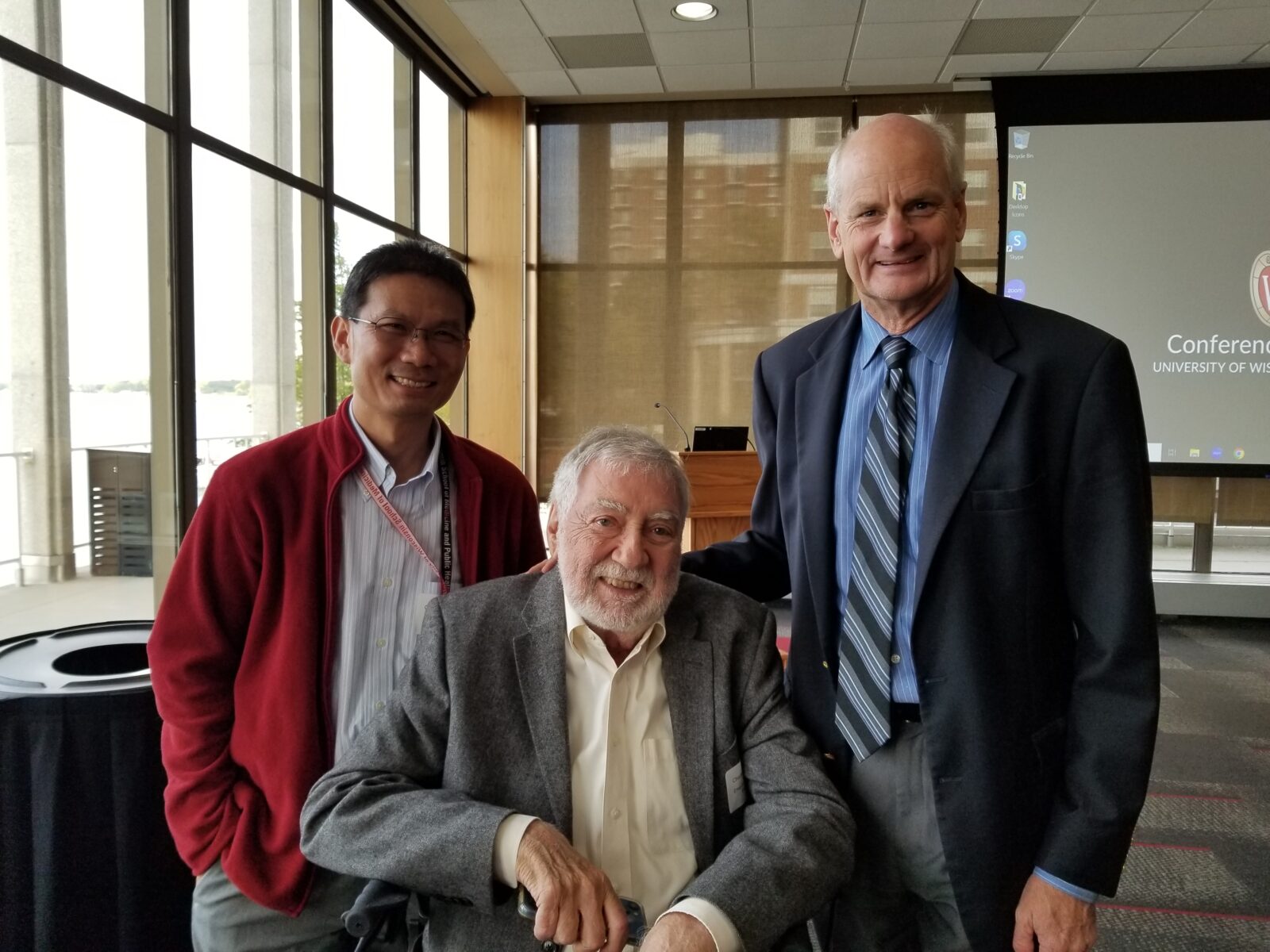
Deeply committed to supporting future generations of imaging scientists, Dr. Mistretta mentored 36 PhD students and 25 postdoctoral fellows, many of whom went on to become leaders in medical physics, radiology, biomedical imaging, and industry. His mentorship extended far beyond technical training. He challenged his students and fellows to pursue work that was bold, clinically meaningful, and capable of improving human lives.
When asked what advice he gave his students, Dr. Mistretta said, “Pick a career that makes a difference in the world and hopefully helps people. When you get old someday and start becoming aware of your mortality, it really helps to look back and say, ‘I did my best, and I helped make the world a little better place.’”
Dr. Mistretta’s influence as a mentor was also reflected in the way he honored those who had shaped his own life. When he received a WARF Named Professorship in 1985, he chose to name it the John R. Cameron Professorship in honor of John Cameron, the mentor who brought him into medical physics. That gesture revealed something central to his character: he understood science not only as discovery and invention, but also as a lineage of mentorship, gratitude, and responsibility.
Decades later, that same spirit continued through those he mentored, including Guang-Hong Chen, PhD, one of Dr. Mistretta’s former postdoctoral fellows, who named his own WARF professorship the Charles A. Mistretta Professorship of Medical Physics and Radiology in recognition of his profound influence on his career.
“It is deeply meaningful to me to hold a professorship named in honor of Chuck,” said Dr. Chen. “I was not trained as a medical physicist, but as a theoretical physicist working at the intersection of physics and mathematics. It was Chuck who reached out to me and invited both me and my wife, an MRI physicist, to join the University of Wisconsin–Madison. He gave me the freedom and encouragement to apply my talent to X-ray CT, a field that became the center of my career. That invitation was a true turning point. Without Chuck, my career would not have unfolded as it did.
Chuck taught me to think boldly and unconventionally, to “build the pyramid upside down,” as he would say. He challenged me not to pursue only incremental improvements, but to imagine technologies that could be ten times better than what already existed. He also taught me to work with people smarter than myself, and to work closely with radiologists and industry partners so that my research could lead to real clinical impact. Naming this professorship after Chuck is my small way of thanking Chuck for his mentorship, his vision, and his profound impact on my career and life. Even so, Chuck left very big shoes to fill, and I continue to feel both the responsibility and the privilege of trying to follow in his footsteps.”
Read Dr. Chen’s tribute in the “National Academy of Engineering Memorial Tributes.”
The UW Departments of Radiology and Medical Physics invite you to share your memories and experiences with Dr. Mistretta.
A Mass of Christian Burial will be held at St. Peters Catholic Church, 5001 N. Sherman Ave., Madison, Wisconsin on Thursday, June 18, 2026 at 11:00 a.m. with a visitation at the church from 9:00 a.m. to 11:00 a.m.
In lieu of flowers, the family has requested that memorial donations be made to Outreach for World Hope – outreachforworldhope.org.