Wisconsin’s new ‘Gail’s Law’ a win for patients, department faculty say
With the passage of a new mandate referred to as Gail’s Law, Wisconsin patients with dense breast tissue or an elevated risk of developing breast cancer have broader access to supplemental screening.
Department faculty say this change, which expands insurance coverage and took effect for some residents on July 1, will help providers detect cancer earlier.

In The Cap Times’ “Wisconsin’s new ‘Gail’s Law’ for breast cancer tests: What to know,” Mai Elezaby, MD explained that some patients with dense breast tissue, which makes it difficult to identify cancer in a standard mammogram, require additional scans. But these come at a cost that can be enough of a financial burden that some patients decline the extra tests.
“This is a very common situation,” Dr. Elezaby said. “We’ve seen in real world experience that financial barriers exist for our patients accessing the tools that we know are helpful in detecting cancer early.”
According to Dr. Elezaby, detecting cancer early means less aggressive treatment and a “very high cure rate.”
The new law requires Wisconsin health plans to provide no-cost coverage for both diagnostic and supplemental breast imaging, like MRIs and ultrasounds, for patients who are at increased risk for breast cancer or whose dense breast tissue can make cancers more difficult to detect on a standard mammogram.
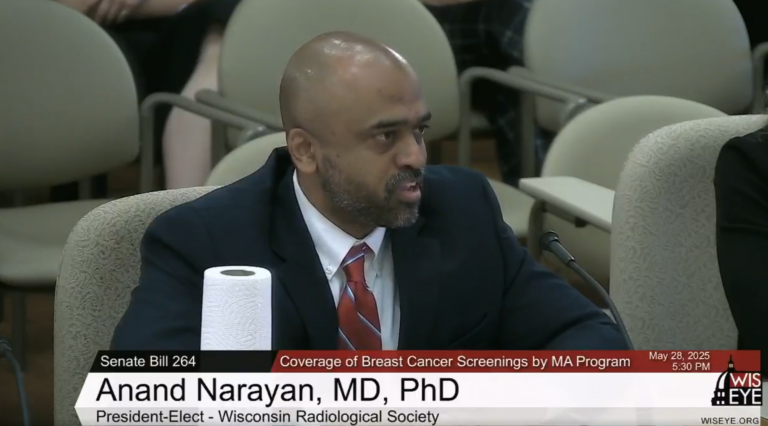
Anand Narayan, MD, PhD has advocated for expanded coverage and testified in May 2025 on behalf of the Wisconsin Radiological Society at a Wisconsin State Senate hearing on measure. Jennifer Bergin, MD a former Breast Imaging and Intervention fellow and resident, also testified.
Dr. Narayan said this measure will help Wisconsin women have access to the tools that can detect breast cancer early.
“Unlike screening mammograms, which are covered by law without copays or deductibles, diagnostic exams can cost a lot of money, even if women have health insurance,” Dr. Narayan said during his testimony. “This often leaves women with a terrible choice: either pay hundreds or thousands of dollars out of pocket to pursue a test their doctors have recommended for them. Or skip the test and hope for the best.”
Gov. Tony Evers signed the bipartisan law in March, and the expansion of benefits took effect July 1 for those on Medicaid. Residents with governmental self-insured health plans, small group health plans through their employers, and individual market health insurance plans will see the change on Jan. 1, 2027.