AI and cancer research discussed on Cap Times Idea Fest panel
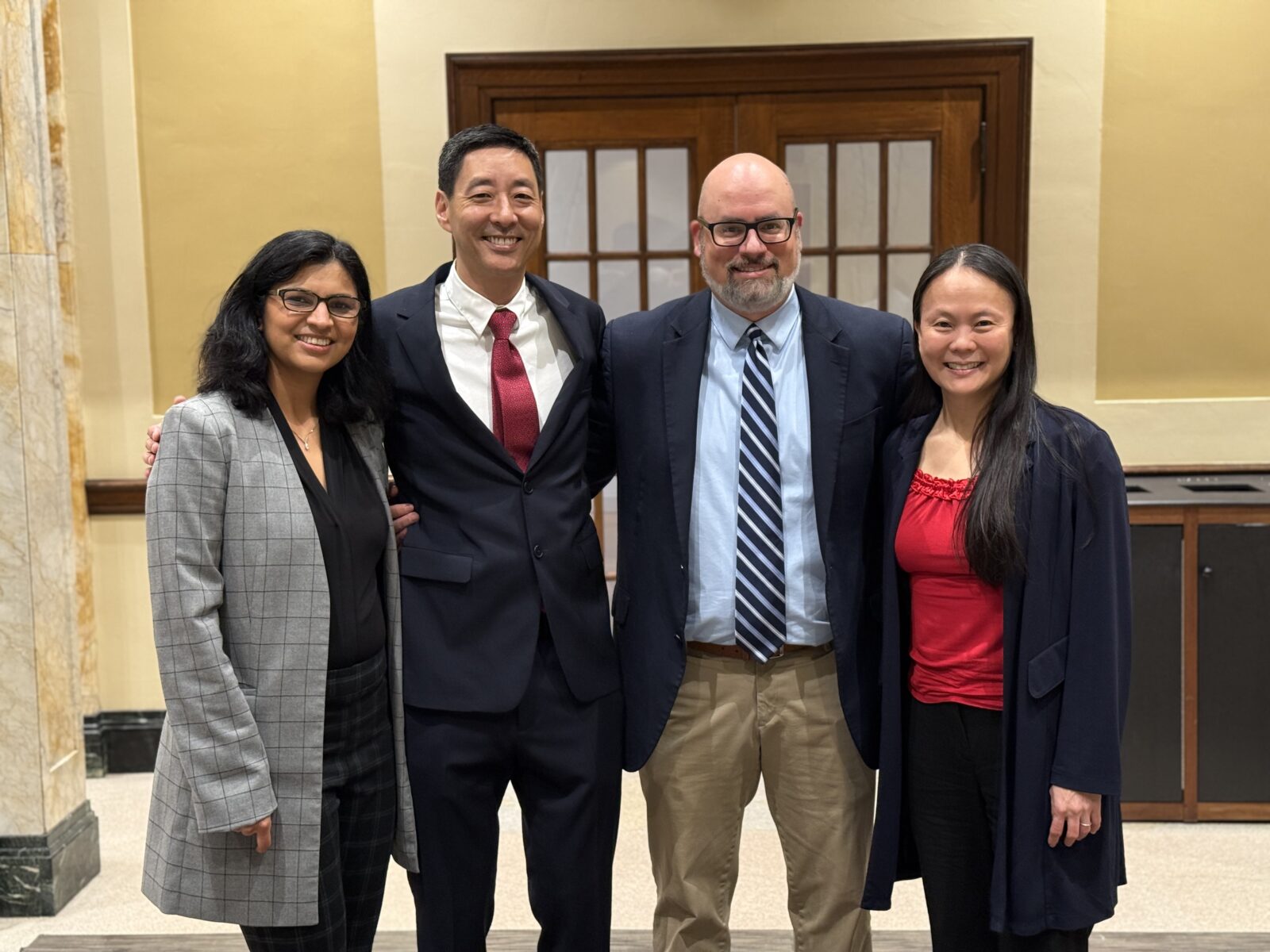
Weighing in on the question of whether artificial intelligence is a friend or foe of cancer research and care, three healthcare experts agreed that the answer isn’t clear cut.
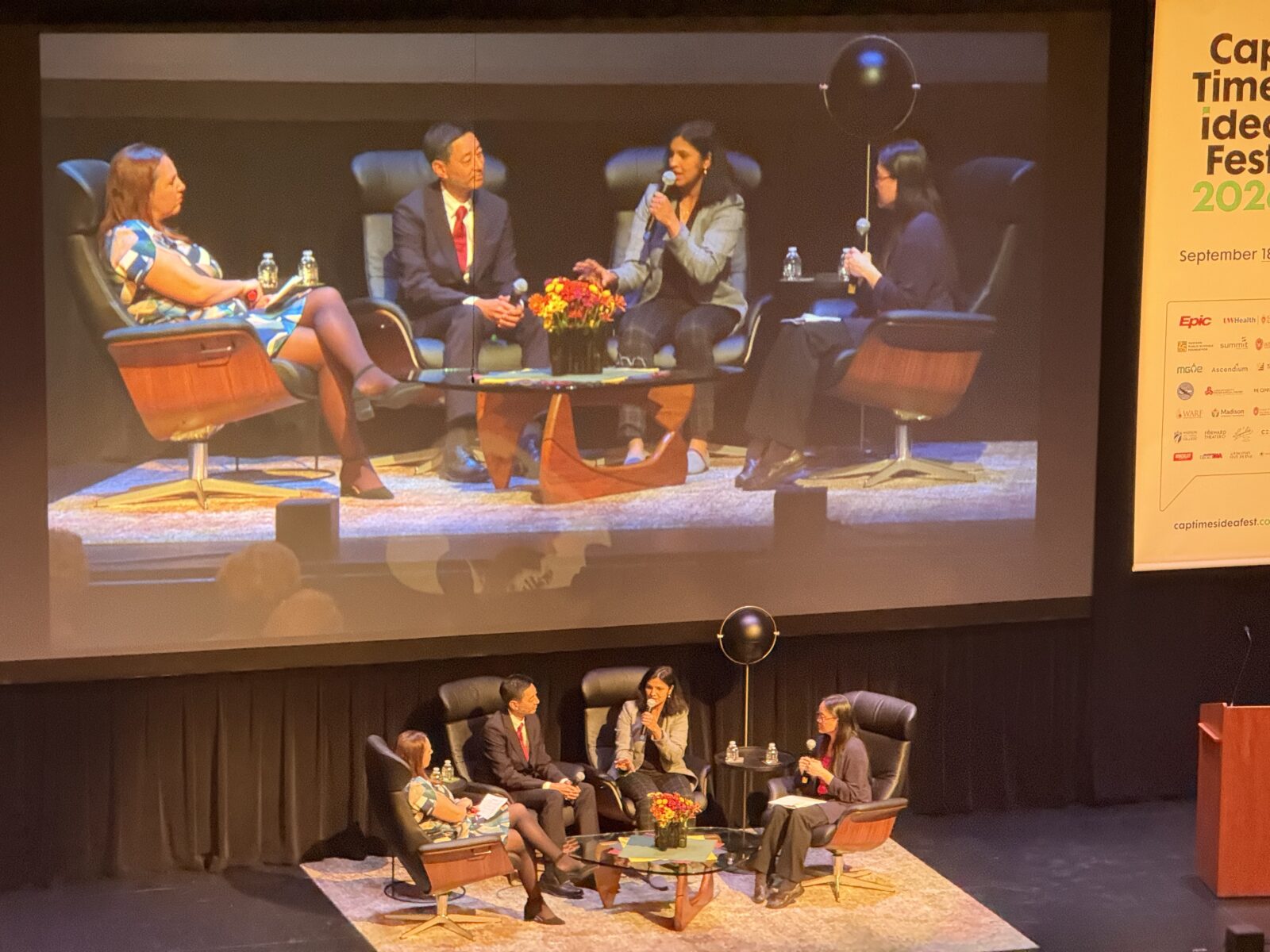
Christoph Lee, MD, MS, MBA; Pallavi Tiwari, PhD; and Irene Ong, PhD participated in a Cap Times Idea Fest panel on Sept. 25. The UW Carbone Cancer Center sponsored the talk and reception, which Director Christian Capitini, MD hosted, ahead of the panel.
Rebecca Ribley, a video producer at UW Health, directed challenging questions to the panelists about how artificial intelligence is transforming healthcare for patients, doctors, and researchers as well as the concerns that come with those changes.
“You can never call (AI) your friend all the time. You can never call it your foe all the time,” said Dr. Lee, professor of radiology and senior vice chair of research. “It’s going to be a partner. Part of the job moving forward for us in healthcare is to realize that complexity.”
AI can be more foe than friend, especially if the technology is learning from biased data sets: “The algorithm is just as good as the data that you put into it,” Dr. Lee said.
Dr. Tiwari, associate professor of radiology and biomedical engineering, urged caution in how doctors are using AI, saying it’s a “constant conversation.”
“The stakes are much higher in medicine, in oncology, in cancer, so the questions are a lot more deeper,” Dr. Tiwari said. “We have to be very, very careful with how these models are trained, how they are used, how clinicians are using them and getting away from the biases that they automatically bring.”
In agreement, Dr. Ong, associate professor of obstetrics and gynecology and an affiliate of the UW Department of Radiology, described the balance of using AI as “walking on a tightrope.”
“Certainly it’s very helpful, and I think it needs to be trained properly. With the right data, it can be a very, very useful assistant,” Dr. Ong said.
But she and Dr. Lee also highlighted the risk of automation bias, or the human tendency to believe automated systems over their own judgement, and challenges in training future clinicians.
“The new doctors and the new students who we’re mentoring, if they rely too much on AI, it’s not going to help them learn how to develop those critical thinking skills,” Dr. Ong said. “But if they don’t use it, then they might miss things that would have been better if they had been flagged by the AI.”
A doctor’s assistant
AI can assist with a variety of efforts in healthcare and cancer research, such as compiling an incredible amount of data and analyzing it to inform a diagnosis. Dr. Tiwari believes AI has huge potential in “bringing all of these pieces of the puzzle together to help oncologists, radiologists, and pathologists make better decisions for cancer patients.”
Dr. Lee described AI as a device that can help doctors detect cancers that they might have missed. For example, Dr. Lee said one in eight breast cancers are not visible on a mammogram to the human eye.
AI is also used to improve efficiency and workflow, which is especially helpful as the quantity of medical imaging and scans are exploding exponentially while the number of radiologists remains steady.
“We’re hoping that AI can improve both our performance of catching cancer earlier but also improve our efficiency,” Dr. Lee said.
Dr. Ong, who researches ovarian cancer, has used machine learning models to sort through over 4,700 records from healthcare visits that hold clues as to whether someone is more likely to have cancer. But the clues may be so subtle that a person flipping through records wouldn’t necessarily find them.
“It can notice patterns that are too tiny or too spread out for a person to be able to catch,” Dr. Ong said.
‘The human aspect’
Will AI replace their jobs? No, but it could help with administrative work like taking notes, writing reports, and filling in data.
“I’d love for AI to take over those tasks that we know that they’re really good at, that aren’t going to put a patient at risk and allow us the bandwidth to do the harder parts of medicine and to really work at the top of our medical license,” Dr. Lee said.
While questions about AI sometimes keep Dr. Tiwari up at night, she knows that it cannot replace the parts of her job like mentoring, which is based on human relationships.
Dr. Ong said AI could take over programming and “looking for that needle in the haystack of all that data.”
“The most important part is the human aspect. The AI approaches cannot yet do any of the reasoning that we can,” Dr. Ong said.
Read more about the panel in this Cap Times article “Madison experts say AI can see cancer humans can’t, but it has limits.”