Anand Narayan CHDR Community Spotlight
The following interview was conducted by the Center for Health Disparities Research (CHDR).
CHDR Community Spotlight: Anand Narayan, MD, PhD (he/him)
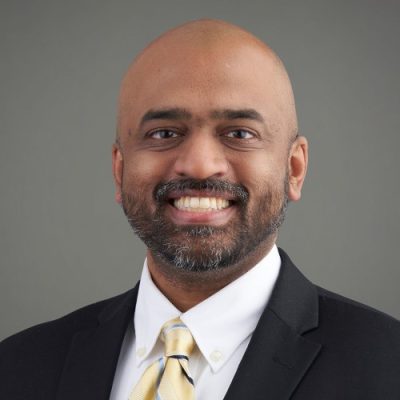
October is Breast Cancer Awareness Month. Here at CHDR, we are lucky to count Dr. Anand Narayan — professor in the Breast Imaging section and inaugural vice chair of health equity in the Department of Radiology — among our affiliated faculty.
Check out our conversation below to learn the latest on research at the intersection of breast cancer and health disparities happening right here in Wisconsin.
Tell us a bit about your work.
The big picture perspective is that my work functions at the interface of clinical operations and research, with a specific focus on reducing healthcare disparities. I’ve been very fortunate and greatly appreciative to be in a position that gives me a seat at multiple tables to think through healthcare disparities, working on research publications and grants but also part of operational discussions to think about reducing disparities specifically when it comes to breast cancer screening and other interventions.
From an operational perspective, we’ve worked closely with our population health team to try to decrease disparities with a specific focus on reducing screening disparities in patients who are living at the highest state deciles of the Area Deprivation Index (ADI). We’ve also used the ADI from a research perspective to identify patient populations that are less likely to have access to imaging services. Then we think about mechanisms for quality improvement and implementation science to drive forward interventions that actually improve those numbers in terms of screening. Ultimately, we hope to see improvements in reducing intermediate outcomes, advanced stage cancers and mortality in the next 10 to 15 years or so.
What brought you to this work?
I used to do a lot of work in the policy sphere, advocating with different organizations around various issues. Then I went to medical school and had an interest in trying to bridge practice and research perspectives to impact clinical care. I was an MD/PhD, and I did my PhD in public health, specifically clinical epidemiology.
All those aspects of my background meld together in my current work, from policy experience working in community organizing and legislative advocacy to working in the healthcare space, taking care of patients and trying to improve outcomes at an individual level, to the public health perspective. In my clinical life, I am involved with both screening and diagnostic breast imaging. We’re identifying abnormalities, talking to patients, getting them set up for biopsies and guiding their cancer diagnoses. And from a public health and population perspective, I’m engaged in both research and administrative work that drives forward interventions to actually have improvements in patient outcomes. All of this combined is about using the tools at our disposal to impact patients’ lives. Having a clinical career does that directly in terms of my own breast imaging work, and then research administrative work allows me to move the needle forward on a larger scale.
How do you connect with CHDR’s mission?
Part of why I was excited to be an affiliate is the level of knowledge and expertise that CHDR convenes to serve the specific mission of catalyzing health disparities research and bringing the benefits of that research to patients. CHDR has really shown that it’s not just about doing research. It’s about taking the knowledge generated through research and using it as leverage to improve policy and practice. I think that’s probably the biggest thing that makes me excited to be a CHDR affiliate, that idea of taking knowledge and information from research and using it to forward policy that drives outcome improvements for the patients we serve.
Finally, if there are others in the CHDR community interested in connecting on how we can share our approaches to getting involved with policy and improving access to services, I would love to continue thinking through that together. Please feel free to reach out to me.