Richard Bruce brings a radiologist’s perspective on AI to legislative committee

Within a year of Wilhelm Rontgen discovering x-rays in 1895, there were approximately 100 publications on how they were used in medicine.
Richard Bruce, MD draws a connection from what the world of medicine and technology saw over 130 years ago to today’s leaders grappling with the use of artificial intelligence in healthcare.
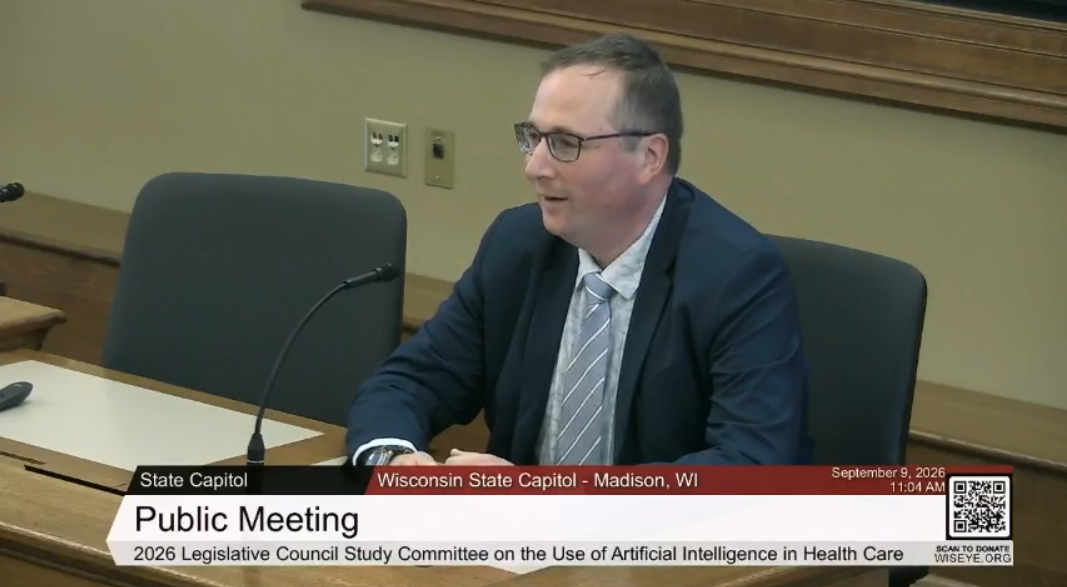
“The dawn of radiology is the closest parallel that we have,” Dr. Bruce said to Wisconsin’s Legislative Council Study Committee on the Use of Artificial Intelligence in Health Care on Sept. 9, 2026. “That explosion in technology and figuring out new and innovating and useful ways to use it is very apt to what we have today.”
The legislative study committee aims to research current and emerging uses of AI technology in healthcare. This includes considering the use of AI technology in the patient-provider relationship as well as between insurers or medical assistance programs and patients and providers. After the reviews, the committee will consider recommending legislation that addresses standards for the use of AI in healthcare services and insurance.
During Dr. Bruce’s presentation, he shared how today’s application of technology outpaces even the field’s rich history of technological innovation.
“I go to work every day and I’m happy where I am because this is an amazing time in history,” he said. “Never before have we seen this kind of opportunity for tool innovation.”
In the field of radiology, AI has been successful in producing better imaging quality, using lower radiation doses, and resulting in fewer errors – “all things that are slam-dunk homeruns from an imaging perspective,” Dr. Bruce said.
Technicians can also use AI for real-time quality checks during ultrasounds, automating labeling, and “coaching” on how to improve image quality.
“We get more efficient, higher-quality healthcare as a result of that,” Dr. Bruce said.
While AI brings innovation that can improve healthcare, Dr. Bruce also highlighted areas of caution. Technology is a “small fraction” of the challenge, he said.
Dr. Bruce encouraged the committee to consider how “we translate discovery into practice.” He said creating an internal governing process, overseeing the quality controls, and integrating new tools into clinical care can be more difficult than the “generation of AI itself.”
“A year from now, the model is not going to be the hard part,” Dr. Bruce said. “How we bring that into the clinical workflow, how we surface that functionality, how we take responsibility as providers around that is going to be the larger challenge.”
He left the committee with a question: “How do we use that to impact the world around us in a positive way?”
To learn more, watch Dr. Bruce’s presentation to the committee on WisEye, review his presentation, and read more about the committee.