Ryan Woods shared with media how AI can support radiologists
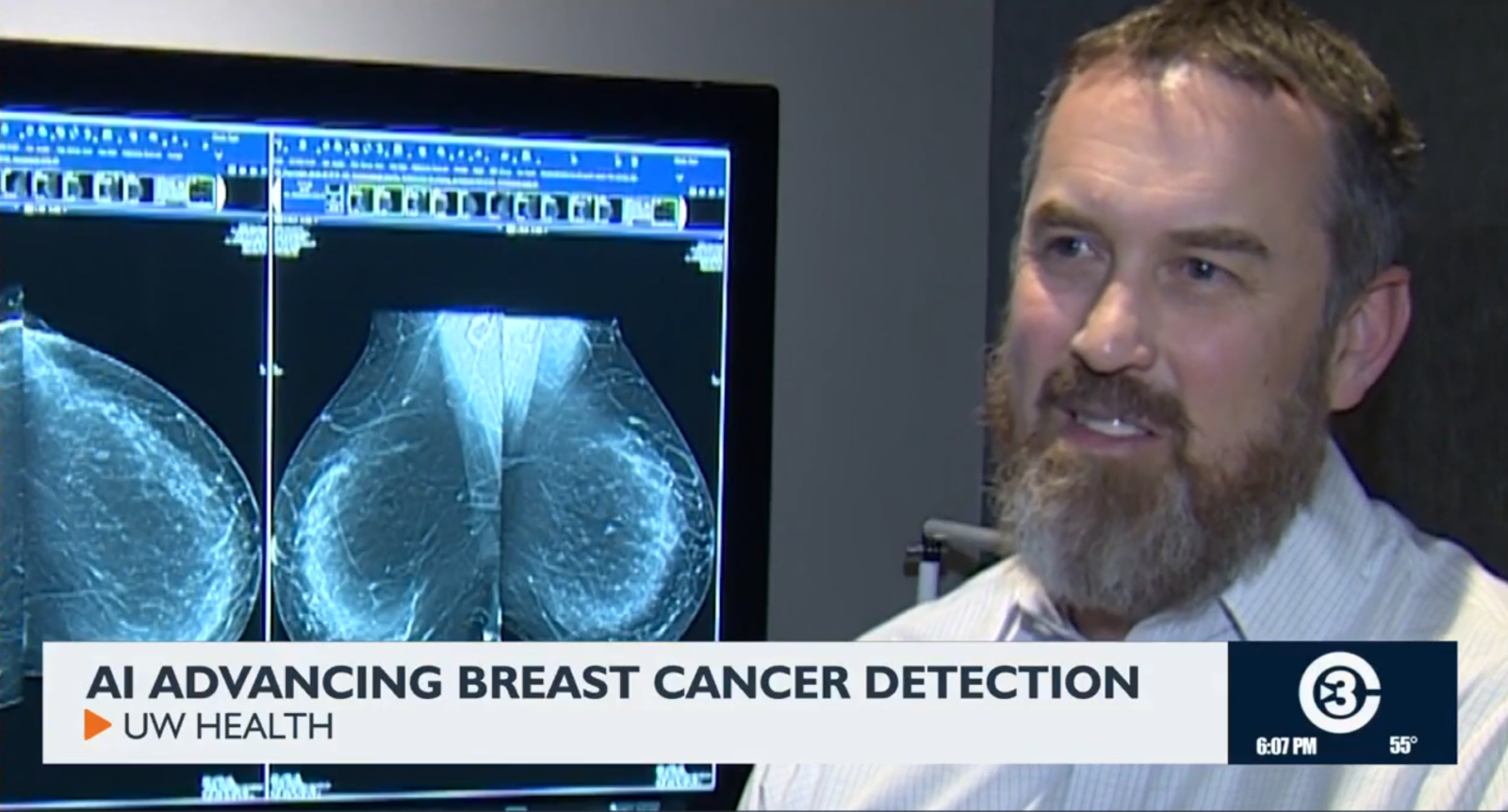
During interviews with Channel 3000 and Fox 2 Morning, Ryan Woods, MD, MPH shared how artificial intelligence can support radiologists in their detection of breast cancer.
Dr. Woods is a co-site principal investigator on the national PRISM Trial (Pragmatic Randomized Trial of Artificial Intelligence for Screening Mammography), which is a study evaluating whether AI can effectively assist radiologists in the interpretation of mammograms.
“(The tool) puts what we call a bounding box around a particular part of the image where it identifies something that may be suspicious. The radiologists use that extra information to determine whether we agree with the tool and say this patient needs to come back for additional imaging and potentially a biopsy,” Dr. Woods explained during an interview with Channel 3000 in a segment called “AI-assisted mammograms tested for breast cancer diagnosis support.”
Dr. Woods emphasized that the tool is not replacing radiologists’ jobs but serving as a helpful resource.
“The radiologists are still in the driver’s seat,” Dr. Woods said. “We’re still making the decisions about what happens next, but we’re using it as one of several things to help us do our work better.”
In an interview with Fox 2 Morning, Dr. Woods underscored that AI is a tool that supports radiologists in their job detecting cancer and that it could be helpful in catching smaller masses that could be missed.
“You can’t know everything and so having a tool like this can really help improve care,” Dr. Woods said. “If more radiologists are using this across the country, across the world, then I think we will see an increase in our ability to detect cancers,” Dr. Woods said.
University of Wisconsin–Madison and UW Health’s leadership in the PRISM trial – including Christoph Lee, MD, MS, MBA serving as a national co-PI and Mai Elezaby, MD as co-site PI – received additional media coverage in 2025 when the trial was announced.